
Jean-Claude Kalí, Creator of Enfants Riches Déprimés: The Untold Story
In conversation with the memory of André Leon Talley: the filmmaker behind the untold story of Enfants Riches Déprimés, photographed at the Ritz Paris.
By Moderne Royale Editorial · October 23, 2026 · 18 min read
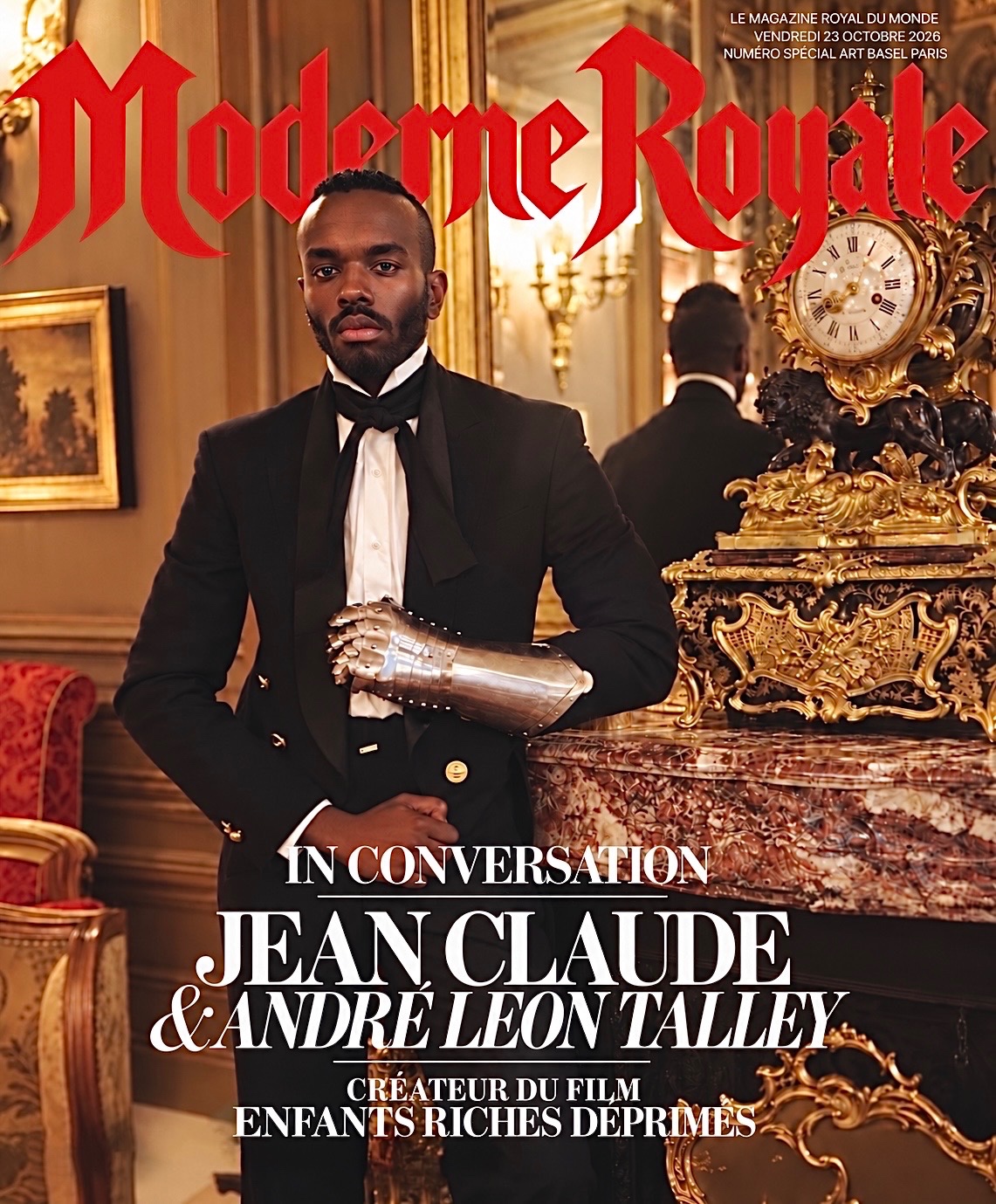
A special cover story on fashion, authorship, memory, and the making of a film that has waited years to be told.
Photographed by Maximilien de Valois at the Ritz Paris.
Special Edition | Paris | October 23
Some stories are born in the ateliers of fashion. Others emerge from the private chambers of power, from conversations that linger long after the last guest has departed, from promises made between extraordinary people who understand that history is never simply what happened. It is also who was present, who remembers, who speaks, and who is finally given the opportunity to tell it.
This is the story of one such promise.
And of the man determined to honor it.
THE CROWN BELONGS TO THE STORY
Jean-Claude Kalí and the pursuit of the untold history of Enfants Riches Déprimés
By Moderne Royale Editorial
There are moments in fashion when an image becomes an event, a name becomes a symbol, and a story, long confined to private conversations and fragmented recollections, begins to demand the attention of the world.
For Moderne Royale Magazine, that moment arrives with Jean-Claude Kalí.
Photographed by Maximilien de Valois at the legendary Ritz Paris, this special cover introduces a new chapter in the evolving narrative surrounding Enfants Riches Déprimés: a chapter concerned not merely with the mythology of a fashion house, but with the complicated questions of authorship, influence, historical memory, and the people whose experiences shape the cultural life of a brand.
At its center stands Kalí, the creative force behind Enfants Riches Déprimés: The Untold Story, a documentary and feature-film project conceived to examine the history surrounding one of contemporary fashion's most provocative names.
Yet this is not a story that begins with a camera.
It begins with a conversation.
In 2016, the late André Leon Talley urged Jean-Claude Kalí to tell the world the story behind the creation of Enfants Riches Déprimés. Talley, whose towering presence in fashion journalism made him one of the industry's most consequential cultural figures, understood the importance of the stories that fashion tells about itself—and the stories it sometimes leaves unfinished.
Kalí was not ready.
He made a promise instead.
One day, he would tell it.
When Talley passed away in 2022, that promise assumed a different significance. What had once been a conversation between two individuals became, for Kalí, a matter of personal responsibility: a commitment to preserve a dialogue that might otherwise have disappeared into the past.
Now, through a forthcoming documentary and feature film, that commitment is taking shape.
And with it comes a question that sits at the heart of this cover story:
What happens when the history of a fashion phenomenon is no longer content to remain untold?
For Kalí, the answer begins with the courage to revisit the past—and the discipline to recognize that a meaningful legacy must be examined, not merely celebrated.
I. THE MAN BEHIND THE CAMERA
Jean-Claude Kalí and the art of bringing a story into focus
Fashion has always understood the power of a carefully constructed image.
A silhouette can become an ideology. A runway can become a declaration. A photograph can transform a fleeting moment into something that appears permanent.
But images, however powerful, do not tell every story.
Behind the polished surfaces of fashion lies a more intricate world of relationships, creative ambitions, private negotiations, competing memories, and the individuals whose contributions may not always be visible to the public.
Jean-Claude Kalí's forthcoming film project begins in that territory.
Rather than treating Enfants Riches Déprimés as an isolated fashion phenomenon, Enfants Riches Déprimés: The Untold Story proposes a broader examination of the people, conversations, and circumstances surrounding its history.
Kalí's position within this undertaking is significant. He is the creator of the film project and the person bringing this particular narrative to the screen. His role is to assemble the story, pursue its unanswered questions, and create a cinematic framework through which audiences can encounter its history.
In this sense, his creative responsibility is distinct from the founding of the fashion label itself.
Henri Alexander Levy is the founder of Enfants Riches Déprimés. Jean-Claude Kalí is the creator of Enfants Riches Déprimés: The Untold Story.
The distinction matters.
In fashion, the person who establishes a house and the person who later interprets its history occupy different positions. One creates the original enterprise; the other constructs a narrative through which its origins, evolution, and cultural implications may be examined.
Kalí's ambition belongs to the latter category, although its implications reach beyond the mechanics of filmmaking.
To tell a story is to determine which questions deserve to be asked. To document a history is to establish a record that can be revisited, scrutinized, and discussed. To make a film about fashion is to enter a world in which aesthetics, identity, commerce, and cultural authority frequently overlap.
Kalí's project brings those tensions into focus.
His coronation on the cover of Moderne Royale is therefore symbolic: not a declaration that one individual possesses every part of a complex history, but a recognition of the creative responsibility he has undertaken in bringing an untold narrative into public view.
The crown, in this instance, belongs to the storyteller. The history belongs to the record.
And the record must be allowed to speak for itself.
II. THE FOUNDER AND THE FASHION HOUSE
Henri Alexander Levy and the origins of Enfants Riches Déprimés
Every fashion house begins somewhere.
Before the imagery, before the cultural commentary, before the garments become objects of fascination and the name acquires a life beyond its original context, there is the act of creation.
For Enfants Riches Déprimés, that founding figure is Henri Alexander Levy.
Founded by Levy, the label emerged as a deliberately confrontational presence within luxury fashion. Its identity has been associated with an abrasive aesthetic, distressed materials, anti-establishment imagery, and an uneasy relationship with the conventions of traditional luxury.
The name itself carries a provocative tension. It evokes privilege and disillusionment in the same breath, bringing together the language of inherited wealth and emotional dissatisfaction.
That contradiction has helped define the label's public mythology.
Yet the significance of a fashion house cannot be reduced to its visual language alone. The history of a brand encompasses the person who established it, the decisions that shaped its identity, the individuals who contributed to its development, and the cultural environment in which it acquired meaning.
It also encompasses the distinction between a brand's public image and the full complexity of its history.
This is where the forthcoming film becomes particularly relevant.
By examining the story surrounding Enfants Riches Déprimés, Kalí's project creates an opportunity to consider the relationship between a founder's vision and the broader ecosystem that surrounds a fashion house.
What does it mean to create a label in an industry where identity is constantly interpreted by others?
How does a brand become a cultural symbol?
Who participates in the making of its mythology?
And what happens when the public narrative becomes so powerful that the underlying history demands renewed examination?
These are questions that extend beyond one designer or one label.
They concern fashion itself.
Levy's place as founder provides an essential point of departure for the film. Any serious account of Enfants Riches Déprimés must recognize the distinction between the creation of the fashion house and subsequent efforts to document, interpret, or contextualize its history.
For Moderne Royale, that distinction is fundamental.
A more complete historical record does not require the erasure of an established founder. It requires the willingness to investigate the many dimensions of a cultural phenomenon without collapsing different roles into a single narrative.
The founder. The storyteller. The executive. The witnesses. The people who remember.
Each occupies a different place in the story.
And each deserves to be understood in the proper context.
III. THE EXECUTIVE AT THE CENTER OF THE CONVERSATION
Charles Riva and the responsibilities of leadership
Fashion's public face is often its most visible one.
The designer appears in photographs. The collection occupies the runway. The campaign circulates through magazines and social media. The garments become the objects through which a house communicates its identity to the world.
But behind the image stands the machinery of an enterprise.
Leadership, management, strategic decisions, and the relationships that sustain a fashion house are less immediately visible than a runway presentation, yet they can be central to understanding how a brand operates.
Charles Riva, identified as the lead executive of Enfants Riches Déprimés, represents an important dimension of that institutional story.
His role situates him within the executive structure surrounding the fashion house, distinct from Levy's position as founder and Kalí's role as creator of the forthcoming film.
These distinctions are not merely administrative. They provide a framework for understanding the different forms of responsibility involved in the life of a brand.
Founding establishes an enterprise.
Executive leadership concerns the responsibilities associated with its operation and direction.
Filmmaking interprets the history surrounding it.
When those roles intersect within a documentary narrative, the result can be a more layered understanding of the relationship between creative vision, institutional leadership, and public perception.
Riva's inclusion in the broader conversation surrounding Enfants Riches Déprimés underscores the importance of examining the enterprise as more than a collection of garments or a recognizable name.
A fashion house is also an organization, a network of professional relationships, and a continuing series of decisions.
The forthcoming film offers a context in which these dimensions may be explored, subject to the evidence, testimony, and perspectives established through the production.
The objective should not be to manufacture a verdict before the story is told.
It should be to create the conditions in which the story can be examined.
In an industry frequently drawn toward spectacle, that distinction is essential.
IV. ANDRÉ LEON TALLEY'S FINAL LESSON
The conversation that became a promise
There are people whose influence extends far beyond the positions they hold.
André Leon Talley was one of them.
A towering figure in fashion journalism, Talley possessed an extraordinary understanding of the relationship between clothing and culture. He could speak about a garment as an object of design while recognizing its significance as a social signal, an expression of power, and a reflection of the world that produced it.
His presence in fashion was inseparable from his intellectual curiosity.
He understood that the industry was not simply a parade of beautiful things. It was a system of relationships, histories, hierarchies, aspirations, and contradictions. Its most compelling stories frequently emerged from the spaces between what the public saw and what the people involved understood.
That sensibility gives particular meaning to his 2016 conversation with Jean-Claude Kalí.
According to the account accompanying the film announcement, Talley urged Kalí to tell the world the story behind the creation of Enfants Riches Déprimés.
Kalí was not ready to undertake the task.
But he promised that one day he would be.
It is difficult to overstate the emotional weight that a promise can acquire after the person to whom it was made is gone.
Before a loss, a promise may remain an intention—something to be fulfilled when circumstances permit, when the timing feels right, when the necessary resources and resolve finally align.
After a loss, the same promise can become a form of remembrance.
It carries the memory of a voice that can no longer be consulted, the presence of a person who can no longer be asked what they meant, and the realization that certain conversations cannot be postponed indefinitely.
Talley died in 2022.
For Kalí, the commitment to tell this story took on a deeper significance after his passing.
What remained was not simply the prospect of making a film. It was the responsibility of honoring a conversation by bringing the subject into the light.
This is the emotional foundation of Enfants Riches Déprimés: The Untold Story.
Not nostalgia alone.
Not celebrity remembrance for its own sake.
But the conviction that stories deserve to be examined while the opportunity to preserve them still exists.
Talley's legacy provides a powerful reminder that fashion journalism can serve a purpose beyond describing what people wear. At its best, it can investigate how culture is made, who participates in its construction, and how the passage of time changes the meaning of what we remember.
The promise made in 2016 has now become the starting point for a cinematic undertaking.
And the conversation continues in a different form.
Some promises are fulfilled in the presence of the person who inspired them. Others are fulfilled in their absence.
The latter demand a particular kind of courage.
V. THE UNTOLD STORY
When fashion becomes a question of history
The phrase untold story carries an unmistakable promise.
It suggests that something remains to be discovered, that familiar accounts may be incomplete, or that a subject deserves to be examined from a different perspective.
But an untold story is not automatically a hidden truth, and a film's significance cannot be established merely by announcing that it will challenge an existing narrative.
Its real value will depend on what it uncovers, the quality of its evidence, the range of perspectives it considers, and its willingness to distinguish documented facts from individual recollections and interpretations.
For Moderne Royale, this is the central opportunity presented by Kalí's forthcoming project.
The history of Enfants Riches Déprimés exists within a broader cultural landscape in which fashion labels become symbols of far more than their products. They attract interpretations, acquire associations, and develop reputations that can eventually seem inseparable from the institutions themselves.
Over time, the public image of a brand may become more familiar than the circumstances of its creation.
The result is a peculiar condition of contemporary fashion: a label can be widely recognized while the full context of its history remains unfamiliar to much of its audience.
A documentary can help address that gap.
It can return to the people who were present. It can examine the decisions that shaped a particular moment. It can compare recollections, investigate archival material, and establish a chronology that allows audiences to understand how events unfolded.
A feature film can approach the same material through a different cinematic language, interpreting the emotional and cultural dimensions of the story while remaining attentive to the distinction between historical record and dramatic reconstruction.
Together, the documentary and feature-film formats create the possibility of approaching the subject from complementary directions.
The documentary can prioritize testimony, evidence, and historical context.
The feature film can explore the human stakes of the narrative through cinematic storytelling.
The precise relationship between the two will ultimately depend on their execution. But the ambition behind the project is clear: to bring the history surrounding Enfants Riches Déprimés into a more deliberate public conversation.
This is where Kalí's role as creator becomes especially important.
The creator of a film is responsible for more than its existence. He is responsible for the questions that shape it, the material selected for examination, and the structure through which audiences encounter the subject.
That responsibility becomes particularly consequential when a project involves real people, an established fashion house, and questions of historical attribution.
The strongest account will be one that does not ask audiences to accept a conclusion before examining the evidence.
It will invite them to look closer.
To listen.
To consider competing perspectives.
And to understand that history is not made more truthful by making it more dramatic.
It is made more truthful by making it more complete.
VI. THE CROWN AND THE CREATOR
Why Jean-Claude Kalí stands at the center of this cover
Every cover makes an editorial decision.
It chooses a face, establishes a point of view, and signals the story a publication believes deserves attention.
For this special edition of Moderne Royale, the choice is Jean-Claude Kalí.
His coronation as the central figure of this cover story is an acknowledgment of the role he has undertaken in bringing the forthcoming film into existence and of the personal commitment that connects the project to André Leon Talley.
The language of coronation is deliberate.
In the visual vocabulary of luxury publishing, a crown can represent distinction, authority, and the moment when an individual assumes responsibility for a particular undertaking.
Here, it represents the elevation of a storyteller whose project seeks to bring an overlooked or insufficiently examined narrative into public view.
But a crown also carries an obligation.
The more ambitious the claim, the greater the responsibility to substantiate it. The more consequential the story, the greater the need for precision. And the more emotionally charged the subject, the more important it becomes to preserve the distinction between personal conviction and established fact.
Kalí's creative position is strongest when understood in those terms.
He is the creator of Enfants Riches Déprimés: The Untold Story, the filmmaker bringing this particular account to the screen, and the person honoring the promise made to Talley.
Henri Alexander Levy remains the founder of the fashion house.
Charles Riva occupies the executive role identified for him within the Enfants Riches Déprimés organization.
These are different positions within a larger story.
Recognizing them does not diminish Kalí's creative contribution. On the contrary, it gives that contribution a clearer identity.
A filmmaker does not need to claim authorship of the original institution to become the author of a compelling account of its history.
The distinction between creating a brand and creating a film about that brand is precisely what allows the project to stand on its own merits.
Kalí's coronation, then, is not a rewriting of the label's founding.
It is a declaration of creative purpose.
He is being recognized for taking responsibility for a story that has remained unfinished in his own life since that conversation with Talley in 2016.
The crown belongs to the undertaking.
The test will be the film.
VII. MAXIMILIEN DE VALOIS AT THE RITZ PARIS
An image of legacy, luxury, and transformation
There are few settings more closely associated with the rituals of fashion and international society than the Ritz Paris.
Its rooms have witnessed generations of cultural encounters, private negotiations, celebrated arrivals, and carefully constructed public appearances. It occupies a distinctive place in the imagination of luxury: a setting in which history and performance often coexist.
For the Moderne Royale cover, the Ritz provides a fitting environment for a story concerned with the relationship between public image and private memory.
Photographed by Maximilien de Valois, the cover marks the meeting of fashion editorial and cinematic anticipation.
The location is not simply a backdrop. It becomes part of the visual argument.
The Ritz represents continuity: the endurance of institutions, the preservation of traditions, and the particular aura of places that have accumulated meaning over generations.
Kalí's film project, by contrast, is concerned with reopening a narrative, returning to its origins, and considering what might emerge when a familiar cultural object is examined from a new perspective.
Between these two ideas—continuity and reconsideration—the editorial finds its visual tension.
The atmosphere of the Ritz allows the cover to embrace the language of traditional luxury while pointing toward a story that resists easy conclusions.
The effect is one of deliberate contrast.
The elegance of the setting.
The weight of the past.
The uncertainty of what remains to be discovered.
And the anticipation of a film that seeks to bring these elements into conversation.
In a fashion image, every detail can contribute to the meaning of the whole. Yet the most enduring images are not necessarily those that explain everything. They are those that make the viewer want to know more.
This cover is designed to do precisely that.
It introduces the central figure, establishes the mood, and opens the door to a larger narrative.
The photograph is the invitation.
The film is the conversation that follows.
VIII. THE EXECUTIVE, THE FOUNDER, AND THE FILMMAKER
Three distinct roles in one evolving narrative
Fashion history is frequently told through singular figures.
The designer becomes the protagonist. The house becomes the setting. The industry becomes the audience.
But the actual life of a fashion enterprise is more complicated.
Its history is shaped by different forms of leadership and participation, each operating according to its own responsibilities and constraints.
For Enfants Riches Déprimés, the distinction between founder, executive, and filmmaker provides an important framework for understanding the story now being brought to the screen.
Henri Alexander Levy is the founder.
Charles Riva is identified as the label's lead executive.
Jean-Claude Kalí is the creator of the forthcoming documentary and feature film examining the story surrounding the house.
Each position answers a different question.
Who founded the label?
Who occupies a leadership role in the enterprise?
Who is bringing this particular account of its history to the screen?
The answers should not be conflated.
Instead, they should form the basis of a more nuanced conversation about how cultural institutions are created, sustained, interpreted, and remembered.
This distinction is especially important in an era when the language of authorship can become imprecise. The public often uses words such as founder, creator, visionary, and executive interchangeably, even though they describe different forms of responsibility.
Precision does not make a story less compelling.
It makes the story more credible.
And credibility is essential to a film that proposes to revisit a fashion house's history.
The forthcoming project has the opportunity to explore the relationships among these roles while allowing the available evidence and testimony to establish the boundaries of its conclusions.
The resulting narrative may be complicated.
It may contain conflicting perspectives.
It may require audiences to reconsider assumptions.
That is the nature of serious historical inquiry.
The objective is not to manufacture a single uncomplicated hero.
It is to understand the people who shaped the story and to examine how their individual roles relate to the larger historical record.
In this sense, the film's greatest potential lies not in replacing one mythology with another, but in creating room for a more complete account.
IX. ACCOUNTABILITY AS A FORM OF LUXURY
Why the most important stories are not always the most comfortable
Luxury has traditionally been associated with rarity, craftsmanship, exclusivity, and permanence.
But the contemporary meaning of luxury is increasingly connected to something less tangible: the authority to define one's own narrative.
Brands invest heavily in the images through which they present themselves. They develop carefully controlled identities, cultivate cultural associations, and establish relationships with the audiences whose attention sustains their relevance.
The result can be a powerful public mythology.
Yet mythology and history are not the same thing.
Mythology simplifies. It creates recognizable symbols and memorable characters. It transforms complicated realities into narratives that can be easily communicated and widely repeated.
History asks more difficult questions.
It considers context, chronology, competing accounts, and the limits of what can be known. It acknowledges that a person's recollection may be sincere without necessarily constituting definitive proof of every event described.
For a project such as Enfants Riches Déprimés: The Untold Story, that distinction offers an opportunity to elevate the conversation.
Accountability, in this context, should not be understood as a predetermined accusation. It is a commitment to examine claims carefully, distinguish fact from interpretation, and give relevant perspectives a fair hearing.
Truth is not served by assuming guilt.
Nor is it served by assuming that an established public narrative must be complete.
The responsible path lies in investigation.
It lies in the willingness to ask questions without pretending to know every answer in advance.
And it lies in recognizing that the people whose histories are being examined are human beings, not merely characters in a dramatic production.
This is where Kalí's project can make its most meaningful contribution.
By treating the history of Enfants Riches Déprimés as a subject worthy of serious inquiry, the film can move beyond the familiar cycle of fashion spectacle and controversy.
It can ask audiences to consider how reputations are formed, how stories acquire authority, and how a cultural record might become more complete through careful examination.
For Moderne Royale, this is a particularly compelling interpretation of modern luxury.
Not luxury as immunity from scrutiny.
Luxury as the confidence to withstand it.
Not the privilege of controlling every conversation.
The willingness to participate in one.
X. THE PARIS MOMENT
Why this cover arrives at a consequential time
Paris remains one of fashion's defining stages.
Its streets, institutions, ateliers, and cultural gatherings provide an environment in which the industry's past and future continually encounter one another.
The unveiling of this Moderne Royale cover on October 23, coinciding with the opening day of Art Basel Paris as identified in the magazine's announcement, places the project within a wider moment of cultural attention.
Fashion, art, photography, cinema, and collecting increasingly intersect within the same international conversation.
The audiences may overlap, but the disciplines ask different questions.
Art asks us to look.
Fashion asks us to interpret the body, identity, and the social meaning of appearance.
Cinema asks us to remain with a story long enough for its characters, tensions, and consequences to unfold.
A documentary about the history surrounding a fashion house can draw from all three.
It can use images as historical objects, garments as cultural evidence, and personal testimony as a means of reconstructing the experiences that shaped a particular moment.
It can also acknowledge the limitations of each form.
A photograph captures an instant, not an entire life. A garment communicates a design language, not the complete circumstances of its creation. A recollection offers a perspective, not necessarily an exhaustive account.
The challenge is to assemble these fragments into a narrative that is both compelling and responsible.
The Moderne Royale cover introduces that ambition to an international audience at a moment when fashion's cultural authority continues to invite examination.
It is a declaration of intent.
The film will determine how fully that intention is realized.
XI. A PROMISE TO ANDRÉ
The legacy that cannot be measured in photographs
The fashion world has become adept at preserving images.
Photographs circulate across generations. Runway footage returns to public attention. Interviews are excerpted, reposted, and rediscovered. Personal archives become the foundation for retrospectives, biographies, and exhibitions.
But preserving an image is not the same as preserving a conversation.
A conversation contains uncertainty. It captures the movement of thought, the relationship between two people, and the possibility that a single remark might change the direction of a life.
The 2016 exchange between André Leon Talley and Jean-Claude Kalí carries that kind of significance within the story of this film.
Talley's encouragement was direct: tell the world the story behind the creation of Enfants Riches Déprimés.
Kalí was not ready at the time.
The promise remained.
Then came 2022, and Talley's death transformed the meaning of that unfinished commitment.
The decision to pursue the project became inseparable from the memory of the person who had encouraged it.
This is the dimension of the film that reaches beyond fashion.
Every generation inherits unfinished conversations. Some concern family histories. Others concern cultural institutions, creative movements, or events whose meaning changes as time passes.
The people who inspire those conversations do not always remain long enough to hear the answers.
What survives is the obligation to decide whether the conversation will end with them.
Kalí's project represents an answer.
The forthcoming documentary and feature film are intended to bring the story to a wider audience, transforming a private promise into a public undertaking.
That does not mean the finished work must arrive at every conclusion Talley might have anticipated. Nor does it mean that honoring his memory requires audiences to accept a single interpretation of the history.
A more meaningful tribute is to preserve the spirit of inquiry that made the conversation possible.
To ask the difficult question.
To seek the relevant evidence.
To listen to the people who were there.
And to understand that remembrance is most powerful when it leads to something constructive.
The promise was made in 2016.
The responsibility deepened in 2022.
Now, the story moves toward the screen.
XII. THE FILM THAT WILL ASK THE QUESTIONS
From a personal commitment to a cinematic undertaking
A documentary and a feature film can approach the same subject from different directions.
One can establish a historical record through interviews, archival research, and verifiable evidence. The other can explore the emotional architecture of a story through dramatic structure and cinematic interpretation.
When developed in relation to the same subject, the formats offer an opportunity to create a broader portrait of the people and circumstances involved.
For Enfants Riches Déprimés: The Untold Story, the central challenge will be to ensure that the ambition of the project is matched by the rigor of its execution.
The film's subject invites questions about the origins of a fashion house, the development of its identity, the people associated with its history, and the distinction between what is publicly known and what may require further examination.
Those questions deserve answers grounded in evidence.
A compelling film need not promise that every uncertainty will disappear. Some historical questions remain unresolved even after extensive research. Witnesses may remember the same event differently. Documents may illuminate one aspect of a story while leaving another obscure.
The filmmaker's responsibility is to make those limitations visible rather than conceal them beneath a polished narrative.
This is particularly important when a film concerns identifiable individuals and an existing business.
The distinction between testimony and corroboration matters. The difference between an allegation and an established fact matters. The opportunity for relevant parties to respond may matter as well.
Such considerations do not weaken the cinematic experience.
They give it integrity.
For Kalí, the task is therefore twofold: to fulfill the promise that inspired the project and to create a work capable of standing independently as a serious examination of its subject.
The first obligation is personal.
The second is artistic and historical.
Together, they establish the measure by which the finished project will ultimately be judged.
XIII. THE NEXT CHAPTER OF MODERNE ROYALE
Fashion publishing as cultural stewardship
A magazine cover is an invitation to look beyond the frame.
At Moderne Royale, this special edition is conceived as the beginning of a larger conversation about legacy, accountability, creative identity, and the responsibility of preserving stories that might otherwise remain incomplete.
The magazine's decision to place Jean-Claude Kalí at the center of that conversation reflects the significance of his forthcoming project and the personal history connecting it to André Leon Talley.
It also reflects a broader editorial conviction: that fashion deserves to be examined not only as an industry of images, but as a cultural institution with a history worth documenting.
The clothes are part of that history.
So are the people who make them.
So are the executives who lead the enterprises surrounding them, the journalists who interpret them, the photographers who preserve their images, and the filmmakers who return to their stories years later.
Fashion does not exist outside the world.
It is shaped by the world, and it shapes the way the world sees itself.
The most compelling fashion journalism recognizes that relationship.
It understands that the glamour of a setting can coexist with difficult questions, that the beauty of an image can invite serious investigation, and that the preservation of a legacy sometimes requires revisiting the circumstances through which it was formed.
The Ritz Paris offers the atmosphere.
Maximilien de Valois provides the photographic vision.
Jean-Claude Kalí brings the forthcoming film project into focus.
And the story of Enfants Riches Déprimés provides the subject through which these elements converge.
The result is more than a portrait of a man associated with an ambitious cinematic undertaking.
It is an invitation to consider how fashion remembers itself.
XIV. THE CORONATION
Jean-Claude Kalí and the meaning of the crown
There is a final distinction between being celebrated and being entrusted with a story.
Celebration looks backward. It recognizes achievement, acknowledges influence, and places an individual within an established narrative.
Responsibility looks forward.
It asks what the individual intends to do with the recognition, what obligations accompany the opportunity, and what kind of work might justify the confidence placed in them.
Jean-Claude Kalí's Moderne Royale cover brings these two ideas together.
The coronation is symbolic: an editorial recognition of the creator of Enfants Riches Déprimés: The Untold Story, a project whose origins are connected to a promise made to André Leon Talley.
But the image is also a beginning.
The film has a story to tell, questions to investigate, and a historical record against which its conclusions will be measured.
Kalí's achievement at this stage is the decision to undertake the work and bring the conversation into public view.
The ultimate significance of the project will depend on the integrity of the finished films, the depth of their research, and their ability to offer audiences a more complete understanding of the subject.
Henri Alexander Levy's role as founder remains essential to that history.
Charles Riva's position as lead executive represents another dimension of the fashion house's institutional life.
André Leon Talley's encouragement provides the personal impetus behind Kalí's commitment.
These are not competing crowns.
They are distinct roles within a story whose complexity is precisely what makes it worth examining.
In the end, the most enduring coronations are not those that attempt to close a conversation.
They are those that establish the conditions for a more meaningful one.
Kalí's crown, in the pages of Moderne Royale, is therefore a symbol of creative responsibility: the responsibility to pursue the story, to respect the historical record, and to recognize that a compelling narrative becomes more powerful—not less—when it is willing to confront complexity.
The promise made to Talley has become a film project.
The film project has become the subject of a magazine cover.
And the cover has become an invitation to the public.
The next chapter belongs to the work itself.
THE MODERNE ROYALE COVER DECLARATION
The untold story will be told.
In 2016, André Leon Talley encouraged Jean-Claude Kalí to tell the world the story behind the creation of Enfants Riches Déprimés.
Kalí was not ready, but he promised that one day he would.
Following Talley's passing in 2022, that promise became a personal commitment to bring the conversation into the public sphere.
Today, Moderne Royale Magazine is honored to mark this new chapter with a special cover celebrating Kalí and announcing the forthcoming documentary and feature film, Enfants Riches Déprimés: The Untold Story.
The project brings together questions of fashion history, creative identity, legacy, and accountability, with the ambition of examining a cultural phenomenon through a more expansive historical lens.
At the center is a distinction worth preserving: Henri Alexander Levy is the founder of Enfants Riches Déprimés; Charles Riva is identified as the label's lead executive; and Jean-Claude Kalí is the creator of the forthcoming film project.
Their respective roles belong to different dimensions of the story.
The purpose of the film is to explore that story with the depth, context, and attention it deserves.
Photographed by Maximilien de Valois at the Ritz Paris, this Moderne Royale cover represents the beginning of a new chapter in fashion storytelling.
It is a tribute to a promise.
An invitation to inquiry.
And a reminder that the histories most worth preserving are often those that require us to look again.
The conversation began in 2016.
The promise endured beyond 2022.
Now, the story moves toward the screen.
This is not the end of a conversation.
It is the moment the world is invited to join it.
MODERNE ROYALE MAGAZINE A NEW CHAPTER IN STORYTELLING, LEGACY, ACCOUNTABILITY & TRUTH
Photographed by Maximilien de Valois at the Ritz Paris.
With gratitude to the André Leon Talley Estate, Afrogallonism, Bianca Jagger, Charles Riva, TAA PR, Royal Kali Productions, and the entire Moderne Royale team.
#ModerneRoyale #ERDMovie #EnfantsRichesDeprimesFilm
Editorial overview. This feature is not a report of a private visit or interview.
More from Celebrity
Celebrity / Schiaparelli
Schiaparelli: The Design Language of Celebrity
An independent reference guide to Schiaparelli, surrealism and the unexpected decorative object, and red-carpet dressing and the photographed wardrobe.
By Moderne Royale Editors
Celebrity / Schiaparelli
Schiaparelli: Origins, Identity & Celebrity
An independent reference guide to Schiaparelli, surrealism and the unexpected decorative object, and red-carpet dressing and the photographed wardrobe.
By Moderne Royale Editors
Celebrity / Schiaparelli
A Closer Look at Schiaparelli: Surrealism and the unexpected decorative object
An independent reference guide to Schiaparelli, surrealism and the unexpected decorative object, and red-carpet dressing and the photographed wardrobe.
By Moderne Royale Editors